Monpas In Arunachal Pradesh Conserve Forests

One of the best forms for environmental conservation happens when natives are involved. They are best able to gauge the situation, look for solutions and implement it well. The Monpas in western Arunachal Pradesh have declared 400sq.km of their forest as Community Conserved Areas. It consists of meadows, forests, rivers and snow-capped peaks.

There are more than 200 species of birds, and many other fauna. Endangered flora and fauna, too, find a home in this region. You can spot the Red Panda, endangered black-neck crane, musk deer, blue sheep and black bear. The place has a concentration of rare, world-class orchids. Alpine and coniferous forests are prominent.

The community depends on the forest for its livelihood, and in turn, the forest can benefit from the people’s watch over it. All the original tribals, or ‘people of the forests’, revere the trees and beings in the forest. Such close association provides a means of symbiotic relationship.

Inevitably, the area becomes a tourist destination. It works both ways: economic means as well as spread of awareness among tourists. Tourists can go mountain climbing and trekking and set up forest camps. At 4,500m above sea level, Potok is the highest trekking area. You can hire a guide, too. Don’t worry about your stay – homestays located deep in the forests will be an exhilarating experience.
READ MORE - Monpas In Arunachal Pradesh Conserve Forests

21st Century Discourse on Dalit Bahujan, Socio-Spiritual & Scientific Revolution

In a historic gathering of campaigners for Dalit Bahujan (India's "untouchables" and lower castes) human rights, Dr. Alana Golmei, a Rongmei Naga tribal woman from North East India released Dr. Kancha Ilaiah's book last evening at Gulmohar, India Habitat Centre, New Delhi. Following a short press conference, a panel discussion featured leading Dalit-Bahujan thinkers interacting on the themes of the book.
While congratulating the author, Dr. Alana said, "I am delighted to release such profound and revolutionary book, which predicts the future of my people and Dalit Bahujans at large, who have been classified as outcastes and untouchable by Brahminical hierarchies and kept under socio-political, socio-economic, socio-religion and socio-educational oppression for last 3000 years. Kancha's ideology will create a welcome debate and discussion in the coming decade on these important issues of true freedom for Dalit Bahujans."
Research scholars, students, civil society members, social workers, politicians, Dalit activists, and journalists - both national and international - attended the book launch and joined the two hour panel discussion. Mr. Yogendra Makwana, Former Home Minister of Gujarat state, chaired the discussion. Panelists included: Prof. Gail Omvedt, an American-born scholar, sociologist, and human rights activist who is an Indian citizen; Dr. Joseph D'souza, International President of the Dalit Freedom Network; Dr. Udit Raj, National Chairman of the All India Confederation of SC/ST Organisations; Prof. Valerian Rodrigues, School of Social Sciences, Jawaharlal Nehru University, Delhi; and Mr. Vivek Mehra, Managing Director of Sage Publications.
Dr. Joseph D'souza, in his panel discussion remarks, said, "Kancha's book, "Post-Hindu India" is the greatest 21st century challenge to the Brahminical portion of Hindu society. It rationally questions and respectfully reveals the caste apartheid facing untouchables, outcastes and the oppressed majority of India."
clip_image002
In his remarks, Professor Kancha Ilaiah said, "Any religion that says all human beings, men and women are created by God equally is a spiritual democracy. Hinduism says all human beings - men and women - are not equally created. They were born unequal, live unequal, and die unequal. I call this spiritual fascism."
Professor Dr. Kancha Ilaiah teaches in the Department of Political Science, Osmania University, Hyderabad. He won the prestigious London Institute of South Asia (LISA) Award for 2008 for his book "Why I am Not a Hindu" and has provided expert testimony to commissions in India and abroad about the Dalit Bahujan struggle.
"The oppressive system of spiritual fascism is detrimental to the future of religion and the flourishing of our great nation. The idea of spiritual justice or varnadharma, used to justify the caste system, as rooted in spiritual inequality is the main factor that will affect the future of Hinduism," said Prof. Kancha.
As Dalit Bahujans continue to struggle against spiritual fascism and search for equality and liberation, the nation seems to be heading toward a civil war, predicted Prof. Kancha. He cited American civil war history, "Racism of black and white in America came to end but only at the end of civil war. I hope we can avoid this."
The event was organised by Dalit Freedom Network in partnership with Sage Publications. Dr. Kancha Ilaiah serves on the Advisory Board of the Dalit Freedom Network.
The Dalit Freedom Network (www.dalitnetwork.org), is a non-partisan, non-government human rights organization founded in 2002 to support the Dalit Bahujan quest for religious freedom, social justice, and human dignity through projects in education, health care, economic advancement, and social justice advocacy and intervention.
Sage Publications is an independent, international publisher of books, journals, and electronic media with offices in India, London, and the United States. Known for a commitment to quality and innovation, Sage is a world leader in scholarly, educational, and professional markets. See excerpt below about the book.
READ MORE - 21st Century Discourse on Dalit Bahujan, Socio-Spiritual & Scientific Revolution

Status of Tribal Sportspersons in the Country

Status of Tribal Sportspersons in the Country
READ MORE - Status of Tribal Sportspersons in the Country

We are not thought of as human

How the Dalit women of Bangladesh are struggling to end generations of oppression
We are not thought of as human
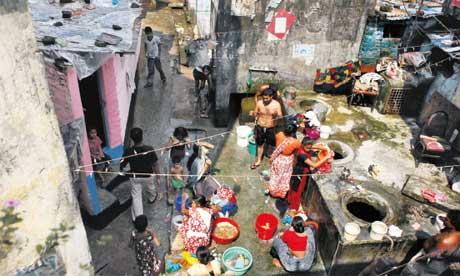
Dalit people wash their clothes and bathe in the same place, with no privacy. Photography by: Abir Abdullah/EPA
'If you are not considered to be human, human rights do not apply to you," says Moni Rani, walking under lines of brightly-coloured laundry decorating dilapidated buildings like bunting.
The kaleidoscopic colours of this cramped south Dhaka community disguise the dark reality that its 4,000 residents live apart from the rest of the city's citizens. As a Dalit, Moni inhabits one of the capital's 27 so-called "colonies", reserved for the men and women destined to do Dhaka's dirtiest jobs. These people, whose ancestors were left out of the four-tier Hindu caste hierarchy, are literally outcasts. Known as "untouchables" because they are shunned by the rest of society, and labelled Harijan (children of God) by Gandhi, they have adopted the name Dalit, from the Sanskrit for "downtrodden".
Based on a notion of purity and pollution, the caste system has led Dalits to be considered unclean and historically, in some communities, they were forced to wear a bell alerting others of their approach. Today, they still face resistance - and often outright refusal - when attempting to enter temples, restaurants and schools, for fear they will contaminate the higher castes.
Reminiscent of apartheid-era South Africa, Dalits - distinguished by their names, sari style, language and accents - are assigned the jobs nobody else wants, including sweeping the streets, burying the dead and manual scavenging (cleaning human excrement from dry toilets by hand). The estimated 5.5 million Dalits in Bangladesh are among 250 million across south Asia. In neighbouring India a successful civil rights movement has gained political representation for the country's 170 million Dalits, but in Bangladesh - where the former British colonial rulers lured Indian Dalits on the broken promise of better jobs, homes and prospects - they are not only a caste minority, but a religious minority in a predominantly Muslim country. In a nation of Bengali speakers, their Hindi and Telagu mother tongues mean access to education, housing, the justice system and the political arena is severely suppressed.
Gabtoli colony sits at the end of a long potholed road; a grey slum stuck on the western edge of the city. Living in a no-man's land of rusty corrugated iron and old bamboo, with no facilities and no privacy, the women of Gabtoli bathe fully clothed at the banks of the Turag - just 200 metres from a large pipe spewing sewage.
In a country where 80% of the population lives on less than $2 a day, Dalits shoulder the further burden of exclusion and entrenched discrimination. Munni Rani Das raises her hand to shoulder-level when describing the floods in rainy season. "When the rains come it brings snakes and dangerous insects to our home," she says. "We try to get away but the rickshaw pullers and bus drivers won't carry us."
Discrimination
Munni, her husband and three teenagers were moved to this flood-prone colony after developers planning to build apartments evicted them from their central Dhaka home. "We protested," she says, "but the army and police came and said, 'If you don't leave we will beat you and shoot you'."
Proffering a cup of murky chemical-scented water, Munni adds: "There, we had safe water and a market. We were near jobs and my children went to school. Now, school is too far away."
The International Dalit Solidarity Network estimates that 96% of Dalits in Bangladesh cannot read or write. Dalits say they need political representation from leaders who understand the extent of the problem, but of Dhaka's 90 elected commissioners, not one is Dalit.
Sitting behind his desk, the commissioner for Dhaka's Ward 85, Alhaj Badal Shardar, says: "I love Dalit people because they are sincere and very simple." When a typical Dhaka power cut kills the lights and the fan, one of the commissioner's men hurries to his side, wafting his boss with a giant fan of palm leaves. "I have never seen any discrimination against Dalits in my community," Shardar continues, "I am 100% sure there is no discrimination."
But, born and brought up in the Telagu colony in the commissioner's ward, Prokashamma Bhodanki insists caste discrimination is rife. The 23-year-old daughter of the late BG Murthy, who seven years ago founded the Bangladesh Dalit Human Rights movement, Prokashamma hid her Dalit identity at secondary school by speaking Bangla, each term taking her Bangla-speaking sister instead of her Telagu-speaking mother to collect her exam results - an event similar to parents' evening at British schools. She recalls: "One time my sister wasn't able to come. When the other students heard my mother speak they said terrible things."
Wiping her tears with her pink shawl, she adds: "For four years I hid my identity from my friends but when they knew I was a Dalit girl they wouldn't eat with me or speak with me. I swore I would never go back to school."
But she did. After finishing her two remaining years, Prokashamma passed her exams and is now teaching English and Bangla to young Dalits. She said: "Now I understand that so many of us are facing that kind of discrimination. I want to fight for my rights and do something for my community and myself."
Prokashamma belongs to a new wave of young Dalit women in Bangladesh who, having swum against the tide to finish school, are now role models, being elected as leaders in their communities and teaching under the Dalit Women's Forum to give the younger generation a fighting chance.
Launched two years ago, the forum provides training in making and selling candles and garments for its 150 members as a first step to financial independence.
Back at her brightly coloured home, forum leader Moni Rani says her father ensured she was the first girl in her community to finish school - and she intends to be the first of many.
"All Dalit women are now conscious of their situation and demanding change," says Moni. "When I was a girl I couldn't get the chances our girls are getting now. Our young women are smarter than me and I feel that is my success. My vision is for hundreds of smart Dalit women coming together and I will gather them under my banner."
READ MORE - We are not thought of as human

Madhya Pradesh villagers being cautioned on climate change

Bhopal, Nov 16 (IANS) With the the global Copenhagen climate change summit just three weeks away, grassroots efforts are on to raise awareness among Madhya Pradesh tribals about the impact of climate change on rural livelihoods.

“Special working groups of livelihoods promoters are being formed in 3,000 tribal villages, under the Madhya Pradesh Rural Livelihoods Project (MPRLP), to caution gram sabhas about the harmful impact of climate change on rural livelihoods,” MPRLP project coordinator L.M. Belwal told IANS here Monday.

The project has encouraged community-based interventions like the development of watersheds, plantations, installation of biogas plants and organic farming that can keep away the harmful effect of climate change.

“These working groups of livelihoods promoters, being formed to caution the gram sabhas about the harmful impact of climate change on rural livelihoods, would discuss at gram sabha meetings how natural resources can be better managed to avert the adverse impact of climate change,” said Belwal.

A strategy was finalised a during a district level meet of livelihoods promoters in Jhabua. Participants included those from Aalirajpur, Mandla, Dindori, Anuppur, Shahdol and Sheopur — all tribal-dominated districts.

The Jhabua meet of livelihood promoters discussed what is climate change, how greenhouse gases work, what is global warming, why glaciers are melting and how natural resource-based livelihoods are getting affected.

“MPRLP, financially aided by the Department For International Development (DFID), UK, which is working through the gram sabha model for sustainable livelihoods of the rural poor, works to eliminate rural poverty by empowering rural households, mainly in nine tribal districts of the state.

“It (MPRLP) takes a bottom-up approach, facilitating, inspiring and guiding community-driven collective and individual action to reduce poverty through gram sabha (village assemblies),” said Belwal.

India will be among 190-odd countries taking part in the Dec 7-18 UN Framework Convention on Climate Change summit in Copenhagen.
READ MORE - Madhya Pradesh villagers being cautioned on climate change

Terrified villagers seek solace in 'IDs'

At 58, Nara Kerketta is facing an identity crisis. The indigent farmer from Dantewada, in the heart of the Maoist bastion of Bastar in Chhattisgarh, knows he is not a Maoist sympathiser. But he also knows the security forces won't believe him when they enter his village in search of the red army.

His tribal hamlet could be set ablaze as a 'Maoist hideout'. Worse, he and his family could end up on the list of 'Maoist casualties' under Operation Green Hunt, the nationwide crackdown on Maoist forces.

"What am I supposed to do? Nobody from the administration is telling us if the fight has already begun. However, I am worried about my family's safety, and I won't take any chances," he says.

So, Kerketta has got 'photo identification cards' made for himself and his family.

He says the cards show they are not Maoists, and believes they will protect the family when the police and paramilitary come calling.

He is not alone. Thousands of hapless tribals caught in the crossfire and desperate to save their lives are running helter-skelter to get themselves such IDs. They are travelling several kilometres to stand in long queues that have formed outside photo studios, as no one here wants to be mistaken for a Maoist.

The trouble is - these IDs are not official. The government is not issuing them, and the police say they carry no value whatsoever.

The election commission had approved about 15 different identity proofs, including voter IDs, ration cards, driving licences and NREGA job cards, for Chhattisgarh voters during last year's assembly polls.

However, many tribals don't have any of them, says Himanshu Kumar, a social activist based in Dantewada.

More recently, as village panchayats began warning the tribals of the impending anti-Maoist drive, tribals started living in fear for their lives. In this dark atmosphere, the talk of photo IDs as the only safeguards has spread like wildfire.

But the state's director general of police Vishwaranjan says the police have not issued an order for such IDs.

"We will find out how this practice has been adopted by villagers," he adds.

In fact, the police are now moving to dissuade the villagers from getting these IDs.

Kanker's superintendent of police Ajay Yadav suspects the whole thing is a racket. And Bastar's inspector general of police T.J. Longkumer has asked officers in his range to tell villagers not to get carried away by hearsay.

A tribal leader and former CPI legislator from south Bastar also says the IDs are of little use as they won't stop security forces from killing innocent villagers. "I know people are travelling several kilometres to get these cards. But we are urging them not to panic," says Kunja, who is also the president of the All-India Adivasi Mahasabha.

But Kusumi Maro, of Chintagufa village, says the residents of her village were persuaded by panchayat members themselves to get these IDs as they could save lives. And Guda Mukhi from Errabore village claims, "We are not with the rebels, but we cannot trust the security forces as well." Many in the administration believe the panchayats are exploiting the fear among the poor tribals to fleece them.

But irrespective of who is doing it, the con of fake identity cards is proof that in the clash between the State and Maoists, the ill- fated tribals always end up the losers.
READ MORE - Terrified villagers seek solace in 'IDs'

Wild elephants attack Chhattisgarh village, tribals flee

RAIPUR: Around 40 families of a forested tribal village in Chhattisgarh migrated to safer areas Sunday after wild elephants went on rampage for two consecutive nights and brought down several mud-built houses, forest officials said.

A group of wild tuskers had Friday night sneaked into Bakalo village in Surguja district, 420 km from here, and demolished three houses. The animals destroyed another four houses Saturday night, forcing the 40 tribal families of the village to migrate to safer areas until the elephants retreat from the nearby Premnagar forested belt.

"It's not a new case that tribals have left their villages for a brief period due to the fear of jumbos in Surguja. It's quite a regular feature in the area and the tribals know that the animals will not stay in their village for more than three-four days," a forest department official said.

Chhattisgarh's vast northern region, comprising Surguja, Jashpur, Koria, Korba and Raigarh districts, have recorded a sharp rise in man-elephant conflicts in recent months.

The state government annually pays people living in villages that are surrounded by forests, millions of rupees in compensation for the loss of human lives and the massive damage caused to houses and crops by wild elephants.

The state government said it is trying to find a permanent solution to the decades-old man-elephant conflict and is willing to work on a proposal by NGO Earth Matters Foundation, which has suggested setting up "elephant villages" to help keep wild jumbos away from areas inhabited by people.
READ MORE - Wild elephants attack Chhattisgarh village, tribals flee

Thousands of Chhattisgarh tribals cross over to

BHADRACHALAM: Thousands of tribal people of Chhattisgarh near the Andhra border, caught in a pincer-like situation, are migrating in large numbers to the Bhadrachalam division of Khammam district.

Harassed by the Maoists, police and Salva Judum alike, about 12,000 tribals of Dantewada district of the neighbouring State have crossed over in the past 12 days, according to informed sources.

According to official information, more than 20,000 tribals have migrated from Chhattishgarh and have been living in Khammam district since 2005.

In the name of Green Hunt, police and Salva Judum forces of Chhattisgarh are allegedly raiding tribal villages, beating them up and even burgling their houses.

Three days ago, the forces allegedly killed six tribals at Kristaram in Dantewada district on the charge that were working as Maoist couriers.

Those terrified people who could not flee to Andhra Pradesh are taking shelter in the deep forests of Chhattisgarh.

The infux of people is causing concern to the Andhra Pradesh police as they think it creates a law and order problem. On the other hand, Maoists are trying to regroup in Andhra Pradesh and are hell-bent on demoralising the forces by striking terror in Khammam district.

The Maoists warned polictical leaders that they themselves had to blame if any thing happened to them.
READ MORE - Thousands of Chhattisgarh tribals cross over to

Uranium mining in Meghalaya finally takes shape

By D. Henpilen

Shillong (Meghalaya), Nov 14 : A much-awaited uranium-mining project, which promises development of the remote West Khasi Hills district of Meghalaya, is finally taking shape.

The State governments decision to allow the Uranium Corporation of India Limited (UCIL) to implement its pre-project developmental package has elicited a positive response from locals.

The state has estimated the presence of about 9.22 million tonnes of uranium ore deposits. The UCIL would invest Rs 2.09 billion to undertake pre-developmental project activities to build schools, hospitals, roads and other infrastructure.

For this purpose, the state government has agreed to release 422 square hectares of land for 30 years to the UCIL.

My press conference is to initiate a more serious debate on the merits and demerits of Uranium mining in the benefits and otherwise on allowing UCIL to start uranium mining right now. I hope that through this press conference it will generate more intelligent debates among the people of the state and I think thestate government also should not be in a hurry to take a decision right now. They should allow the public air out their views and opinion on uranium mining, said Micheal Syiem, a social worker.

The state government does not have its own fund, it all depends on the central government. So there are still many areas to be developed. So by the fund we receive from the central, it is not enough. So special funds that comes from the government of India that we have found theuranium so it is a blessing to the state. If left to the state alone, it will take years to develop. So now, they have got a road up to Mawthabah from Wahkaji it has been a blessing for them, said S.H.Shylla, former MLA, West Khasi Hills District.

There were protests against the mining of Uranium by different organisations in the State citing health hazards.

However, the Atomic Minerals Directorate for Exploration and Research (AMD) has already executed exploratory mining in the area including processing the ore to yellow cake.

It has also confirmed that there will be no spill over effect on health either to the inhabitants or the cattle.

As a villager of Mawthabah I find that as per the research carried out by the department of Atomic Energy since surveying, drilling up to refining of the yellow cake there is no track of health hazard till date. Even in the place where the grinding machine and the processing plant is laid, now trees have grown and vegetation is green and there are no signs of such affect to the vegetation, said W.S.Lyngdoh, a villager, Mawthabah.

Various public hearings at the proposed site for open cast mining have also been organised in which residents and headmen of various villages surrounding the proposeduranium project site participated.

The State Government has also constituted an expert committee on health to study the implications of uranium mining.
READ MORE - Uranium mining in Meghalaya finally takes shape

Tribals protest against Tata’s Chhattisgarh steel project

Bastar(Chhattisgarh), Nov 14(ANI): Hundreds of tribals, including women, in Chhattisgarh’s Bastar district reiterated their opposition at a public hearing against a Tata steel plant project being set up in Bastar.

Tata Steel plans to invest Rs 195 billion in a steel plant spread across 5,000 acres that will create 5.5 million tons of steel per year, but tribals are against it.

“We have to attend this meeting, where around ten villages have participated to protest against the Tata’s steel plant. The Government is asking for our lands, but if we will give away our lands, there will be nothing left with us. How will we earn our living and what will we feed our children with? We don’t want jobs, we just want our lands,” a tribal said.

Environmentalists claim the steel plant will adversely affect the environment and the lifestyle of the people.

Prakash Jha, an environmentalist and a filmmaker, said the government should take steps to ensure environmental safeguards.

“We are not against the development of the region. The construction of the plant is a good thing, as it promises to provide employment opportunities to locals, but this should be evaluated correctly. The Government should take steps to protect against the effects of the industrial plant,” Jha said.

Source: Tribals protest against Tata’s Chhattisgarh steel project
READ MORE - Tribals protest against Tata’s Chhattisgarh steel project

Urgent need to stop exploitation of tribals in India

Government should create more and more infrastructure facilities like roads, bus depots, and other basic requisite markets in remote areas all of which would contribute effectively to improve the lot of the masses including tribal people.

There is an urgent need to prevent exploitation of tribal people throughout the country. Prime Minister Dr Manmohan Singh has rightly requested all the Chief Ministers present during a recent conference on ‘Implementation of the Forests Rights Act, 2006’ held in New Delhi, to ensure that problems faced by all the tribal people throughout the country are mitigated to a great extent. Chief highlights of the conference are as follows, along with a few of experts' opinion as to how best to tackle this issue:

Prime Minister, Dr Manmohan Singh asserted, "The systematic exploitation and social and economic abuse of our tribal communities can no longer be tolerated. But the fact is that no sustained activity is possible under the shadow of gun.” “We have to win the battle for their hearts and their mouths,” he added.

The Prime Minister said the problems faced by the tribal communities were complex and required sympathetic and systematic understanding. The National Tribal Policy should factor in the different nuances of tribal life as they exist in several parts of our great country. For this, he suggested that the Ministry of Tribal Affairs engage in wide public consultation and debate.

Dr Singh stressed the need to reflect on how to improve the laws and mechanism through which compensation is provided to displaced tribal people, Dr Singh said these people must benefit from the projects for which they have been displaced. He further added, “But resettlement and rehabilitation raise serious issues not just of monetary compensation.

We have to address issues relating to creating sustainable livelihoods, preserving traditional sense of community and helping the tribals cope with the trauma of dislocation and alienation. ”Calling upon the chief ministers, most of whom didn’t turn up — to spare no effort to ensure effective implementation of The Scheduled Tribe and Other Traditional Forest Dwellers (Recognition of Rights) Act, 2006, the Prime Minister said: “We can’t have equitable growth without guaranteeing the legitimate rights of these eventually marginalised and isolated sections of society. The distribution of titles (under the act) is but an important and necessary first step.” The act attempts to deal holistically with the issue not only in terms of recognition of rights but of livelihood opportunities and environmental protection and conservation.

Emphasising the importance of posting committed and competent officers in tribal areas, PM asked the states to consider offering string incentives like hardship allowances, special housing and educational facilities or grants for officers who stay in tribal areas. He also suggested reviewing and withdrawing cases registered against the tribals under the forest laws, which had often become a source of harassment and exploitation.

A few more opinions of experts' given below for debate / consideration:

Some experts opine that the common problems faced by the tribal groups are (a) they have no security whatsoever for living in a house, earning a regular income and accessing medical needs; though there are numerous schemes introduced by the government for their upliftment, no teacher is willing to go to a remote place to work in a school; no doctor is willing to go to a remote place to work in a hospital and no banks would like to invest in a remote place to cater to the financial needs. Though there are many laudable schemes introduced by the government, their proper implementation is absent in many places and also many of these schemes are just on paper with no awareness whatsoever amongst the target groups.

Government should create more and more infrastructure facilities like roads, bus depots, and other basic requisite markets in remote areas all of which would contribute effectively to improve the lot of the masses including tribal people. To a question as to who are the direct source of people connected with exploitation of tribal people, answers given were mostly the business class community especially those who had migrated from different states in search of better business opportunities are the ones who do not hesitate to exploit the tribal people to the hilt for self interests promotion.

Most of these business people do not have a good formal education and therefore resort to all sorts of tricks of the trade to further their business in the shortest possible time and here is where the loophole exists prompting the triabl people to easily fall prey to the whims and fancies of these business class people thereby causing distortions to the smooth progress of the society.

Experts opine government should ensure every paisa committed to the welfare of
the tribal people reach them though suggesting is easy because vested interest groups always try to thwart the benefits reaching these tribal people. It is also opined that big corporate giants have sincerely done something to uplift the tribal group populace, though selectively. Therefore, more and more big corporate giants should be encouraged to reach out to the different areas of the country, with novel schemes, for bettering the lot of the tribal people. Government should also offer tie ups with big groups for systematic improvement amongst the tribal community.

Furthermore, it also found that out of numerous NGOs operating in the country for the betterment of the tribal groups, many of them act like ‘fly by night operators’, only a handful of these NGOs are sincerely attempting to find out their genuine problems and trying to solve them. Therefore, government must tie up with big corporate groups and credit worthy NGOs for solving the numerous issues faced by tribal groups.

One opinion is to popularise the concept of condoms amongst the tribal populace so that growth in population is checked for better serving them. Experts need to device ways and means to make this a success. Any group or person succeeding in this solo effort richly deserves Bharat Ratna and much more.

Hoping the state governments do take the above issue seriously to come out with good doable and workable solutions for the betterment of the tribal populace.
READ MORE - Urgent need to stop exploitation of tribals in India

Chhattisgarh to initiate development in tribal-dominated regions: CM

Raipur: Hit hard by the Maoist insurgency, Chhattisgarh Chief Minister Raman Singh plans to unleash massive development programmes to better the lot of tribals in the Bastar and Surguja regions.

Raman Singh, who leads a Bharatiya Janata Party (BJP) government here since 2003, said his government had disposed of hundreds of thousands of cases of petty forest crimes involving tribals by paying fines on their behalf.

Stung by the shock defeat in an assembly by-election in the Vaishali Nagar constituency, Raman Singh outlined his plans for the tribals who comprise 32 percent of the 20 million plus population of the state, the majority in Surguja and Bastar regions.

"The tribals need care and development and I have plans to pump in massive money in the next four years in the state's Surguja and southern Bastar regions infested with Maoist militancy," Raman Singh told media in an interview.

Raman Singh claimed that the government had distributed vast areas of forest land to thousands of tribals in the past few months.

"In recent months, 140,000 tribals were given ownership rights of forest land on which they have been living for decades. Nearly 200,000 forest-related cases, several of them pending for two decades, were withdrawn," the 57-year-old politician said.

He said the cases were withdrawn after the government realised that the tribals were not in a position to pay even a few hundred rupees as fine to the authorities.

"I have formed powerful bodies like the Surguja Development Authority and the Bastar Development Authority. They are empowered to take decisions on how to build road infrastructure and improve health and education facilities, besides anything that can improve the quality of life of the tribals," said Raman Singh, an ayurvedic doctor by profession.

The chief minister admitted that in certain areas of the state human trafficking of tribals was flourishing, mainly by placement agencies who exploit the poor and uneducated tribals by promising a good career in metros and other cities.

Asked how a placement agency lured minor tribal girls into flesh trade by promising them jobs as domestic help in big cities, Raman Singh said: "District authorities have been asked to bust such rackets and act tough against the placement agencies." (IANS)
READ MORE - Chhattisgarh to initiate development in tribal-dominated regions: CM

Bastar tribals rush for photo IDs ‘to stay alive’

By Sujeet Kumar

Dantewada (Chhattisgarh), Nov 9 Panic-stricken tribals in Chhattisgarh’s restive Bastar region have been desperately knocking on the doors of photo studios. They believe they will be branded as Maoists and killed by the security forces unless they can produce photo identity cards.
While police dismiss their fears as completely unfounded, the tribals are taking no chances, what with the BSF and ITBP joining the state police and CRPF in the past week for a renewed offensive against the rebels.
Arjun Singh, who runs a photo studio in the Sukma block of Dantewada district, some 450 km south of here, told IANS: “Speculation is rife that police will wipe out local people by branding them as Maoists or Maoist sympathisers if tribals fail to produce photo I-card.”
He claimed that in the 10-12 days, some 40-50 tribals had been approaching him on a daily basis to get photos clicked.
Worried residents of hundreds of villages have been travelling several kilometres a day on foot to reach photo studios in the hope of making photo I-cards.
Manish Kunjam, president of the All India Adivasi Mahasabha, told IANS: “The entire interior population under Bastar’s 12 assembly constituencies is highly scared and panicking at reports appearing in the media that police will storm into villages soon to eliminate Maoists and also kill local people by branding them as Maoists.
“That’s why people are rushing to get photo I-cards to produce before the police force, hoping their lives will be spared then.”
The Mahasabha is known as an umbrella group of tribal organisations. Kunjam, a former legislator of the Communist Party of India, is based in Dantewada district.
The rumour comes against the backdrop of a fresh assault in the rebel-dominated interiors of the state’s 40,000 sq km Bastar area. It has been a Maoist-hotbed since the late 1980s.
A top police official in the Bastar range said he was fully aware of this development. “It looks like the sudden rush by tribal people for a photo I-card from private people or groups is a tactic by Maoists. There is no question of police doing anything to people on the basis of whether or not they have photo I-cards,” T.J. Longkumer, Bastar’s inspector general of police, told IANS.
He said superintendents of police (SPs) in five Bastar districts - Bijapur, Dantewada, Narayanpur, Kanker and Bastar - had been asked to appeal to and convince people that “no one need run scared about the anti-Maoist offensive.
“Even those families that don’t have any I-card - voter I-card or bank or post-office pass books - should not worry at all, they will not be targeted. The forces will hit only the guerillas and their hideouts,” he said.
Officials at the police headquarters in state capital Raipur say the Bastar region is home to some 10,000 Maoist militants.
At least 1,500 people have been killed in the state since 2004 in Maoist-related violence, with more than 90 percent casualties reported from the Bastar region.
READ MORE - Bastar tribals rush for photo IDs ‘to stay alive’

Tribals to protest denial of right to forests

New Delhi: Tribals from across India will hold protests on Tuesday and Wednesday alleging the government is imposing illegal and dangerous afforestation programmes and sending police to repress the forest dwellers, an NGO said Monday.

The protests will be held in Delhi, Gandhinagar, Udaipur, Bhopal, Raipur and Bhubaneshwar, said a member of Campaign for Survival and Dignity (CSD), a forum for some 200 NGOs working for the rights of tribals and forest dwellers.

According to CSD, the government is not serious about implementing the Scheduled Tribes and Other Traditional Forest Dwellers (Recognition of Forest Rights) Act, 2006, which was passed to recognise the rights of tribals and forest dwellers over their land, forest produce and community forests.
READ MORE - Tribals to protest denial of right to forests

Doctor couple does wonders for tribals at Sittilingi

hospital2Sittilingi is a remote village in Dharmapuri district, 125 km away from Salem town in Tamil Nadu, which used to be a god forsaken land caught under the spell of quacks and black magic. Noisy drums and fake injections were all that they had to resort to curing illnesses. This is when Regi and Lalitha took the plunge. This doctor couple went ahead to provide medical services to the tribals of Sittilingi, leaving their promising careers in the cities.
The couple found their calling in service to the underprivileged and wanted to use their knowledge where it was needed the most. Their hunt for the right place to offer their service ended at Sittilingi, a totally neglected and ignored tribal village. They ventured into the village, faced tough resistances and now they have emerged successful in establishing a full-fledged medical center for the tribals. A service beyond praises!
Regi and Lalitha called their service the Tribal Health Initiative (THI). Their perseverance and continued service has brought about dramatic change in the living conditions of the natives. Infant mortality rate in Sittilingi has reduced to 20/1000 and there are no mothers dying in childbirth for the past 5 years. The nutrition levels of children and the general well being of the people have improved to a great extent.
Another striking fact about the Sittilingi initiative is that the girls who serve as nurses at the medical center are personally trained by Regi and Lalitha. When Regi and Lalitha saw that it was extremely difficult to get nurses to work at this tribal village, they decided to go choose smart and trainable girls from the village. This became such a wonderful uplift to the self esteem of the girls that they are extremely proud to be part of this initiative and to serve their community.
THI’s approach to medical care went one step ahead in educating the people and ‘helping the tribals help themselves’. They wanted to create a general understanding about health and health issues and make the natives acquainted with basic first aid. Today, over 21 neighbouring villages are benefiting from the Tribal Health Initiative that sprung at Sittilingi.
And, the couple didn’t stop with medical facilities. They organize educational programmes, cultural activities and community development initiatives. There is a library facility that is available for children who also get to listen to motivating stories from a community worker every month.  Truly commendable, right?
It is very heartening to know about the selfless and committed service of Regi and Lalitha and many others who are supporting them. You can visit them at Sittilingi and get to know their service better. We also encourage you to support the initiative by contributing to the cause. Visit http://www.tribalhealth.org/
READ MORE - Doctor couple does wonders for tribals at Sittilingi

ADC's engineering cell to be merged to Tribal Development corp

Imphal, November 2 : The engineering cell of the Manipur Hill District Autonomous Council will be merged to the Manipur Tribal Development Corporation Ltd.

The process for merger before the end of the current financial year 2009-10 has started, official source said today.

In order to facilitate the process to merge the engineering cell, government has asked not to entrust or deposit funds for fresh works with the two wings (wing-I and wing-II) of the cell.

The process for repatriation regular employees of both non-technical and technical staffs of the cell also started, the official disclosed.

Officials of the District Council Engineering Cell and Manipur Tribal Development Corporation have also been asked to seat together and work out all necessary steps like the status of the officers and staff of the cell within the financial year 2009-10 under the merger modalities, it added.

The six Hill Autonomous District Councils of Manipur had established the District Council Engineering Cell/Section (wing-I &II) under the administrative control of the Hills Department of the Manipur government.

The main objective of setting up the cell was for mobilizing resources of the district council by undertaking deposit works for various government works of the Autonomous District Councils.

Cabinet of the SPF government under the chair of the Chief Minister O Ibobi Singh, after thorough discussion on the merger proposal two times, on April 29 and September 14 of this year, approved the merger of the engineering cell to the Manipur Tribal Development Corporation Ltd, a statuary body under the Hills Department.

Following the decision, the two wings of the engineering cell (DCEC, wing-I and wing-II) were asked not to taken up process for receiving fresh deposit works from any other department of the government.

State finance department had issued an order regarding the matter, the source said.

The two engineering cell is currently in 20 deposit works of different departments of the state government.

Most of them are nearly completion and other are in progress except the construction of district hospital in Ukhrul district which is yet to start.

As the two wings of the engineering cell are bound to complete execution of the on-going deposit works before the merger, the authorities concern have been asked to ensure completion of the work within the current financial year 2009-10 .

To avoid legal complicacies, the cell has been asked to complete at least the ongoing works by obtaining deposit for the ongoing works and complete the works in hand and handed over to the depositors, the source said.

The Cabinet seating on September 14 last reviewed the decision of merger of the cell and approved the proposal for allowing completing the ongoing deposit works to be taken up by the engineering cell as well as payment of bills to the contractors within the financial year 2009-10 .
READ MORE - ADC's engineering cell to be merged to Tribal Development corp